Content SEO in Saudi Arabia means creating Arabic and English content that Saudi people actually search for, trust, and act on, and that Google and AI tools like ChatGPT choose to show and cite.
I have worked on Saudi websites for years: clinics in Riyadh, stores on Salla, contractors in Dammam, and B2B firms chasing Vision 2030 projects. The same problems show up again and again. Content is translated from English. Keywords ignore how Saudis really talk. Pages look nothing like a trusted Saudi business. And almost nobody checks what AI assistants say about their brand.
This guide fixes that. It moves from the basics to advanced tactics, and ends with a 30 point checklist you can use to audit any business.
What content SEO means in Saudi Arabia in 2026
Content SEO is the part of SEO that deals with what is on your pages: the topics, the words, the structure, and the proof that you know what you are talking about.
In 2026 it has three jobs:
- Rank in normal Google results and Google Maps.
- Get cited in AI answers such as Google AI Overviews, AI Mode, ChatGPT, Gemini and Perplexity.
- Convert Saudi visitors into calls, WhatsApp messages, bookings and sales.
A page that ranks but does not convert is a cost. A page that converts but is never found is invisible. Good content SEO does all three.
How Saudis search today
Before you write one word, understand the searcher.
Mobile comes first. Most Saudi users browse and buy on smartphones. Your content must read well on a small screen, in right to left layout.
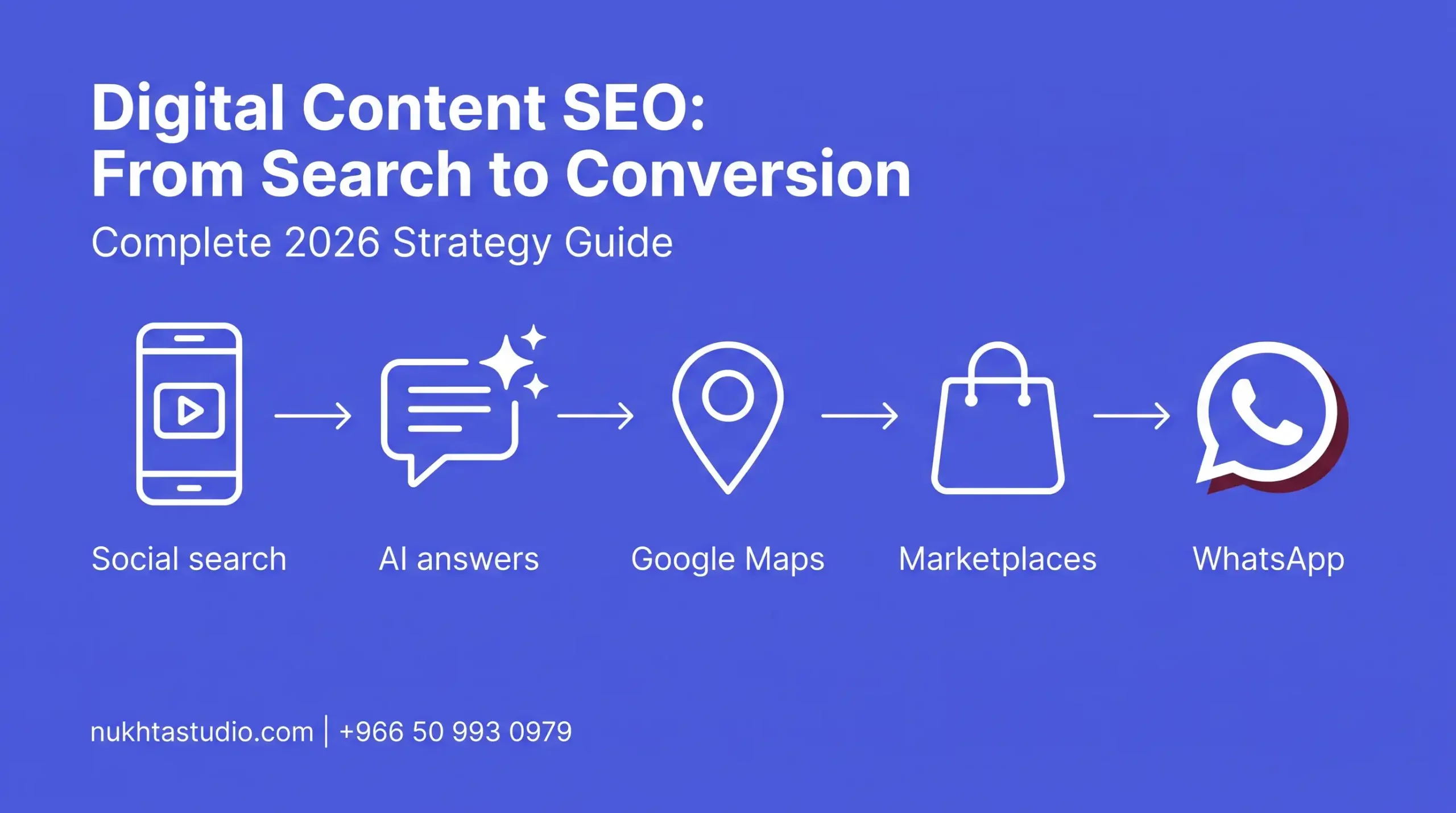
Google is not the only search box. A young shopper in Riyadh may look up a cafe on TikTok, check photos on Snapchat, read reviews on Google Maps, then compare prices on Amazon.sa or Noon. A buyer of used goods starts on Haraj. Your content strategy must match this journey.
AI answers are now part of search. Many Saudis ask ChatGPT or Gemini questions in Arabic, and Google shows AI Overviews and AI Mode in Arabic. Saudi Arabia is also investing heavily in its own Arabic AI through SDAIA and HUMAIN. If your content is not clear enough for an AI to quote, you lose visibility even when you rank.
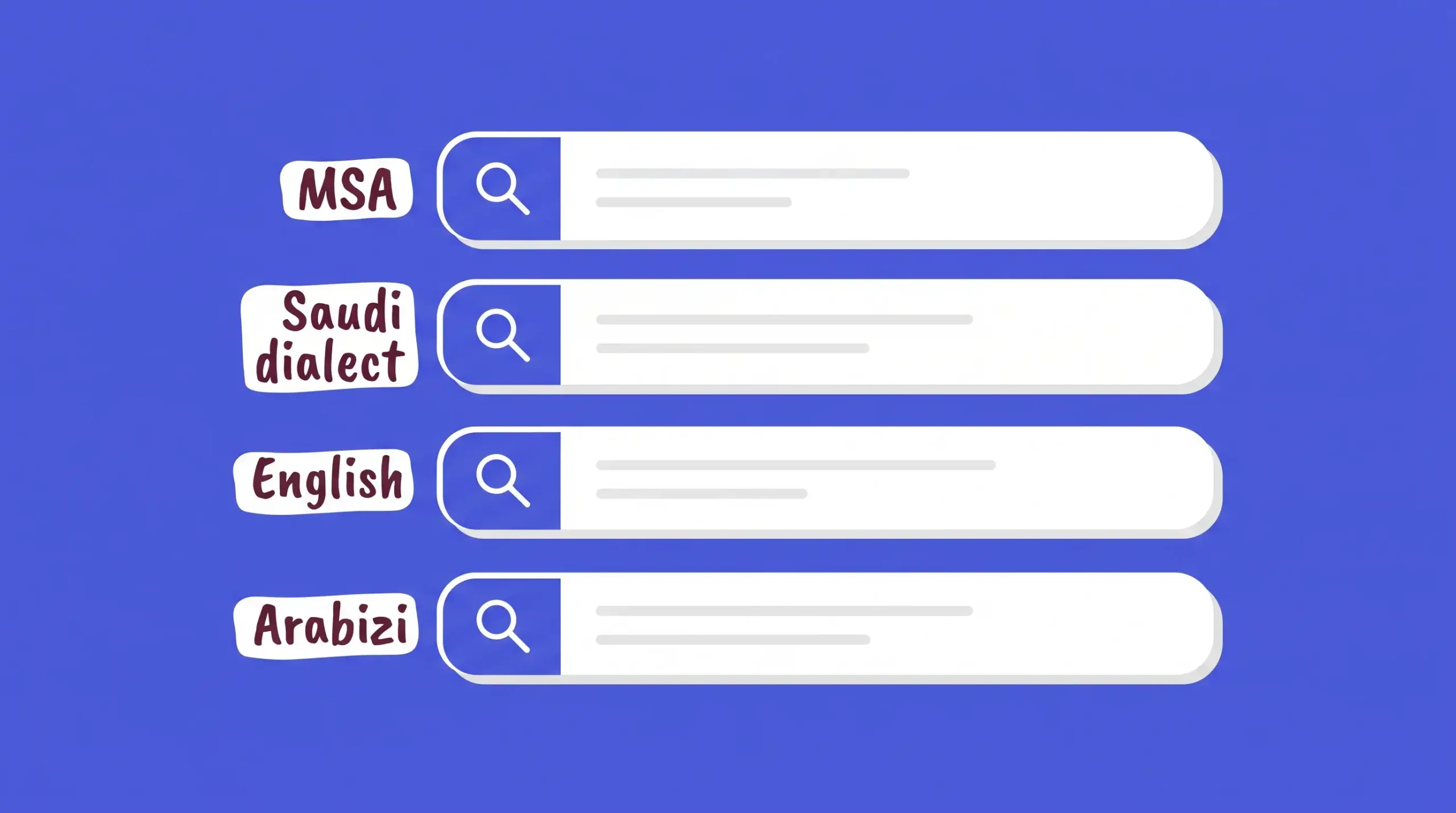
Language is mixed. Saudis search in four ways, often in the same week:
| Type | Example |
|---|---|
| Modern Standard Arabic | افضل شركة تنظيف في الرياض |
| Saudi dialect | وين احصل سباك قريب |
| English | best dentist riyadh |
| Arabizi | 3yada asnan |
B2B, tech and luxury buyers often search in English. Local services and daily purchases lean Arabic. You need to know which one your customers use.
Arabic and bilingual keyword research
Keyword research tells you what people type and what they want when they type it.
Step 1: Collect seed ideas from real Saudi sources
Tools are useful, but start with places where Saudis actually talk:
- Google autocomplete and “People also ask” in Arabic, with your location set to Saudi Arabia
- TikTok and YouTube search suggestions
- Google Maps reviews of you and your competitors
- Questions your sales team and WhatsApp support receive every day
- Haraj listings and marketplace product titles
Step 2: Check the numbers carefully
Arabic search volumes in tools like Semrush and Ahrefs are often too low or missing. Cross check with:
- Google Search Console, which shows the real queries you already appear for
- Google Ads Keyword Planner, filtered to Saudi Arabia
- Google Trends, set to Saudi Arabia, to see seasonal peaks
A keyword with “zero volume” in a tool can still bring you customers every week.
Step 3: Map dialects and spellings
The same idea is written many ways in Arabic. Build a sheet like this:
| MSA | Saudi dialect | English | Intent |
|---|---|---|---|
| صيانة مكيفات | تصليح مكيف | AC repair riyadh | Urgent service |
| عيادة أسنان | دكتور اسنان قريب | dentist near me | Local booking |
| متجر إلكتروني | متجر اونلاين | online store saudi | Commercial research |
Also cover spelling variants such as ة and ه, ى and ي, and أ, إ and ا. Google understands many of them, but using natural variants in headings and FAQs still helps you match more searches.
Step 4: Sort by search intent
Every keyword has a reason behind it:
- Informational: “ما هو السيو” (what is SEO)
- Commercial: “افضل شركة سيو في الرياض” (best SEO company in Riyadh)
- Transactional: “سعر خدمة السيو” (SEO service price)
- Local: “شركة سيو قريبة مني” (SEO company near me)
Match the page type to the intent. A guide for informational searches. A service page for commercial and transactional. A location page for local.
Step 5: Split by city
Riyadh, Jeddah, Dammam and Khobar, Makkah, Madinah and Abha behave differently. Prices, terms and seasons change. A pest control company, for example, sees very different demand timing in Jeddah than in Riyadh.
Content strategy and site structure
Random blog posts do not build rankings anymore. Structure does.
Build topic clusters
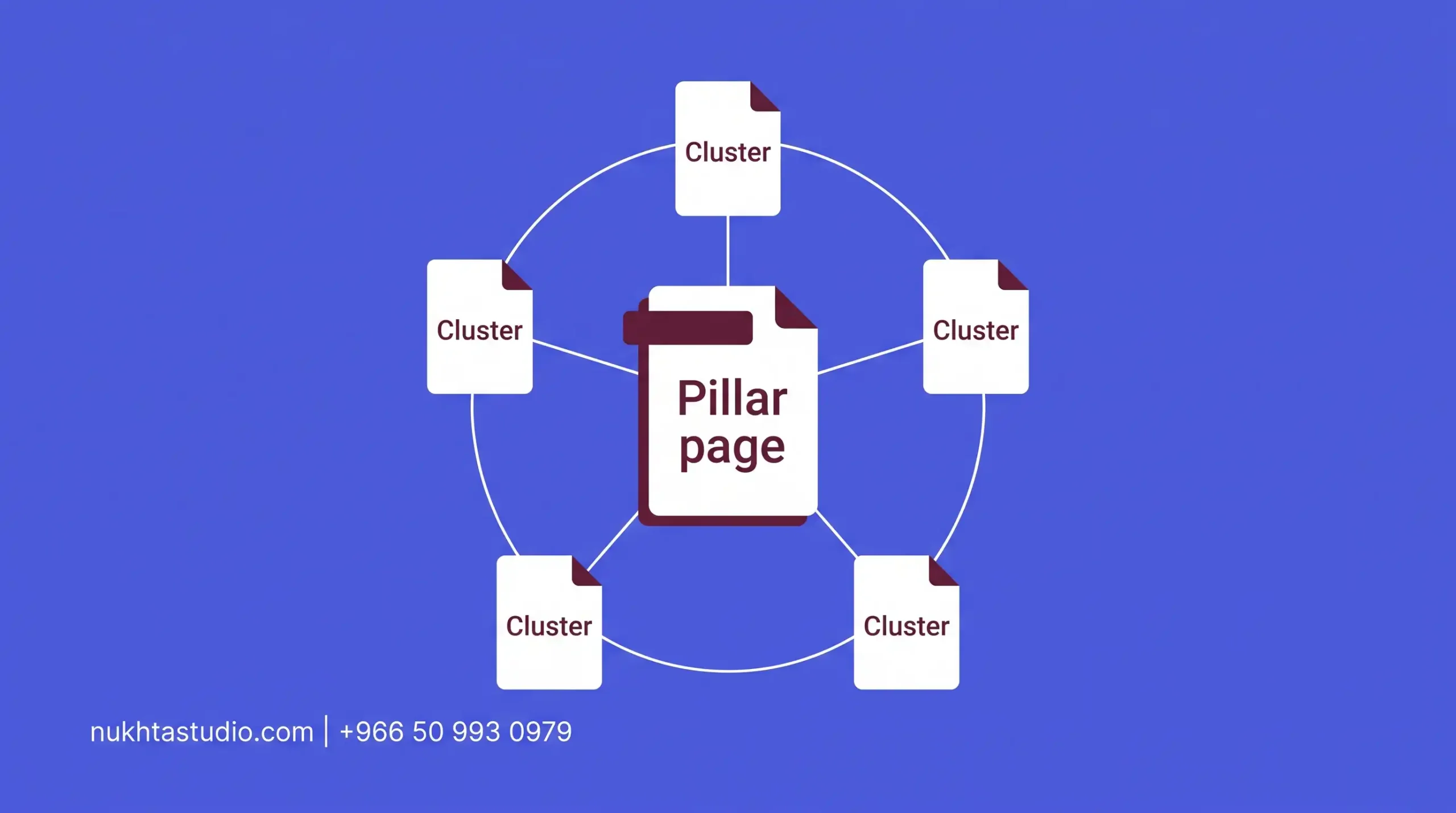
A pillar page covers a main topic in depth. Cluster pages answer the smaller questions and link back to the pillar. For a dental clinic:
- Pillar: Dental implants in Riyadh
- Clusters: implant cost, implant vs bridge, recovery time, implants for diabetics, financing with Tabby or Tamara
This tells Google and AI tools that you are an authority on the whole topic, not just one keyword.
Set up languages correctly
- Use subfolders like
/ar/and/en/. - Add hreflang tags:
ar-SAfor Arabic anden-SAfor English. - Make Arabic the default for local businesses.
- Write each language properly. Never publish raw machine translation.
- Pick one URL style (English or Arabic slugs) and stay consistent. English slugs are easier to share.
Link pages together
Internal links guide readers and search engines. Every new article should link to its pillar, to one or two related articles, and to a service page.
Clean up old content
Many Saudi sites carry years of thin or translated pages. Update what can be saved, merge duplicates, and remove what has no value. Less but better content usually ranks higher.
Writing Arabic content that ranks
This is where most Saudi websites lose.
Sound Saudi. Content that reads like Egyptian Arabic, Levantine Arabic, or a stiff translation loses trust fast. Use Modern Standard Arabic for authority. Add light Saudi touches in consumer content where your brand allows it.
Answer first. Put the direct answer in the first two lines, then explain. This helps readers, featured snippets, and AI citations.
Keep it easy to read.
- Short paragraphs of two or three sentences
- Clear H2 and H3 headings that match real questions
- Lists and tables for steps and comparisons
- Simple words over fancy ones
Use local details. Show prices in SAR including VAT. Mention Saudi rules where they matter, such as ZATCA for invoicing, SFDA for food and cosmetics, or MOH for health. Use Hijri and Gregorian dates when timing matters to your readers.
Check RTL display. Mixed Arabic and English words, numbers, tables and bullets often break in right to left layout. Test every page on a phone.
Write titles and meta descriptions in Arabic for Arabic pages. Arabic characters have different widths, so preview how they display in results.
Use AI as a helper, not the writer. AI tools help with research and outlines. A native Saudi writer or editor should write and review the final text. Google ranks helpful, experience based content, not mass produced text.
E-E-A-T and Saudi trust signals
Google’s E-E-A-T stands for Experience, Expertise, Authoritativeness and Trustworthiness. In Saudi Arabia, trust has local signals that most guides ignore.
Show your business is real. A skeptical Saudi customer should verify you in 30 seconds. Display:
- Commercial Registration (CR) number
- VAT number
- Saudi Business Center verification
- National address and a Saudi phone number
- Working hours and a WhatsApp contact
Show real authors. Add author bios with real names, photos and credentials. For health content, a doctor registered with the Saudi Commission for Health Specialties carries weight. For engineering, the Saudi Council of Engineers.
Show local payment trust. Mention Mada, Apple Pay, STC Pay, Tabby and Tamara. Saudis often search for which stores accept these.
Show reviews. Collect Google reviews and reply to each in Arabic. Add genuine testimonials and case studies to your site.
Respect privacy law. Your privacy policy and cookie consent should follow the Saudi Personal Data Protection Law (PDPL). It is a legal need and a trust signal.
Cite Saudi sources in sensitive topics. For health, money and legal content, reference Saudi authorities like MOH, SAMA and the Ministry of Justice, not only Western sources.
Local content for Google Maps
For service businesses, local search often brings more customers than blog traffic.
- Complete your Google Business Profile in Arabic and English. Add services, products, photos, posts and answers to common questions.
- Create real location pages. Saudis search by district, like حي الملقا or حي النرجس in Riyadh. Each page needs unique content: local projects, directions, team, and reviews from that area. Copying one page and swapping the city name is a doorway page and can hurt you.
- Keep your name, address and phone the same everywhere, including Apple Maps, which matters because iPhone use is high in the Kingdom.
Seasonal content calendar
Saudi demand moves with the Hijri calendar and national events. Plan content four to six weeks before each peak.
| Season | Content ideas |
|---|---|
| Ramadan | Late night offers, gift guides, iftar and suhoor content. Search activity shifts to late evening. |
| Eid al-Fitr and Eid al-Adha | Gifts, clothes, travel, family events |
| Hajj and Umrah seasons | Travel, hotels and services in Makkah and Madinah |
| Founding Day (22 February) | Heritage, national pride, special offers |
| Saudi National Day (23 September) | Green themed campaigns and offers |
| White Friday and 11.11 | Deals, comparisons, best buy lists |
| Back to school | Supplies, uniforms, laptops |
| Riyadh Season and summer | Events, entertainment, travel |
Tip: Build one evergreen page for each season and update it every year. Do not publish a new URL each year. The old page keeps its links and history.
Technical content health
Great content fails if Google cannot load or understand it. A content SEO should check:
- Speed on mobile. Arabic web fonts are often heavy. Use font subsetting and good font loading.
- Indexing. Make sure Arabic URLs are indexed and have correct canonical tags.
- Structured data (schema markup). Add Organization, LocalBusiness, Article, Author, Product with SAR prices, FAQ where allowed, and Breadcrumb. Fill in Arabic values on Arabic pages.
- JavaScript content. Some Salla, Zid and custom stores hide content behind JavaScript. Check that the text is visible in the page source.
- Core Web Vitals in Google Search Console, especially on mobile.
Ecommerce content
For stores on Salla, Zid, Shopify or WooCommerce:
- Write unique Arabic product descriptions. Supplier copy appears on hundreds of sites and ranks nowhere.
- Add content to category pages. A short buying guide and FAQs about delivery cities, returns, and payment options turn thin category pages into ranking pages.
- Create comparison content such as “best air fryer in Saudi Arabia” to compete with affiliate and review sites.
- Align with marketplaces. How your products are named on Amazon.sa and Noon affects your brand searches on Google.
Content for AI search and LLMs (GEO and AEO)
This is the advanced layer, and the one most Saudi businesses are missing.
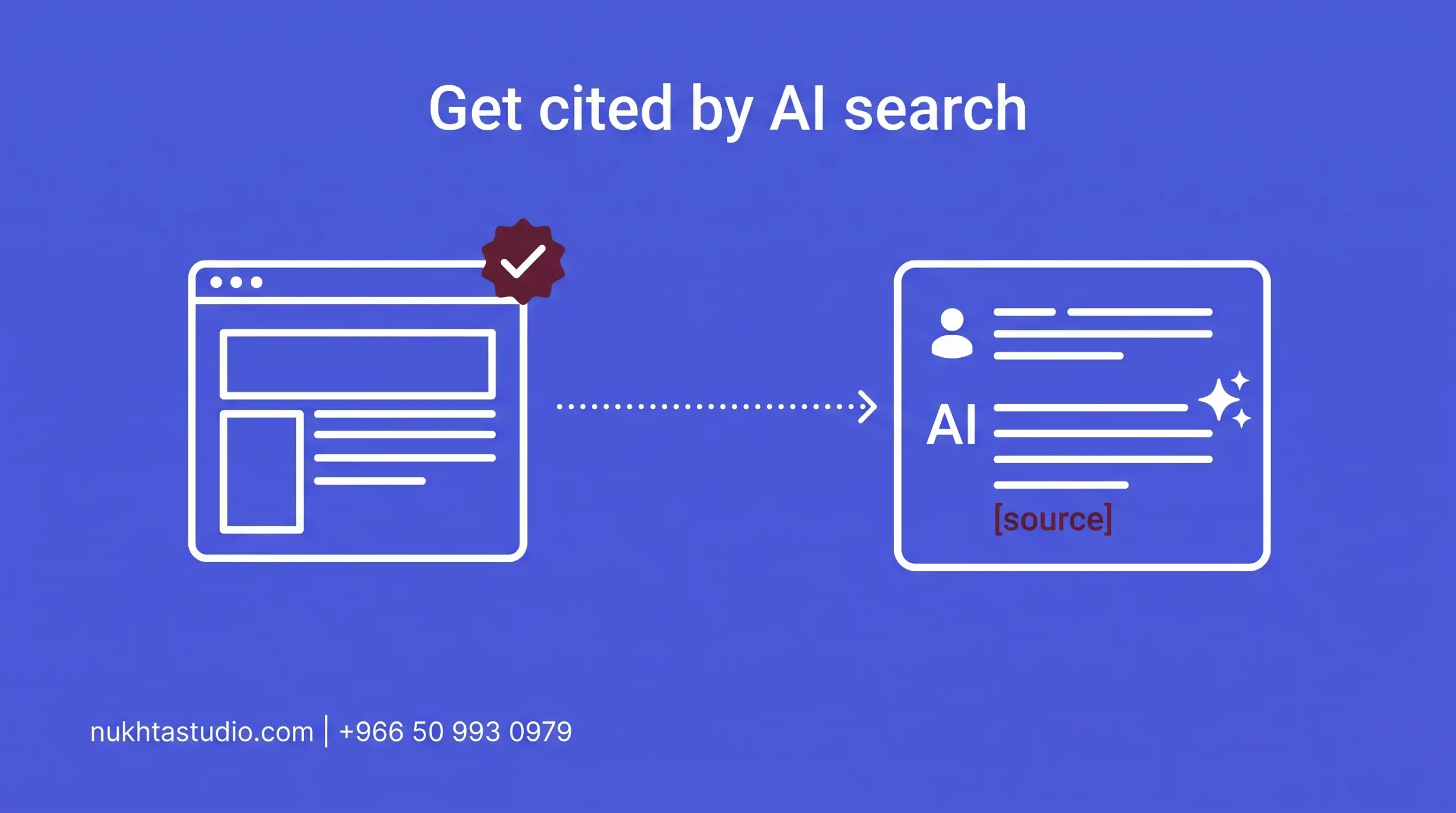
Large language models (LLMs) like ChatGPT, Gemini and Claude, and Google’s AI Overviews and AI Mode, now answer questions directly. They pull facts from pages they trust and sometimes link to them. Optimizing for this is called Generative Engine Optimization (GEO) or Answer Engine Optimization (AEO).
The good news: Google has said its AI features use the same foundations as normal search. Pages must be indexed and helpful. There is no secret trick. But some habits make you far more likely to be cited.
Write quotable facts. Clear sentences like “A basic SEO audit in Riyadh usually takes one to two weeks” are easy for AI to reuse. Vague marketing lines are not.
Define your entity. Say clearly who you are, what you do, where you work, and since when. Keep these facts the same on your website, Google Business Profile, LinkedIn, directories and press.
Answer real questions. Use question headings and short direct answers, followed by detail. Add FAQ sections based on what customers really ask.
Publish original Saudi data. Surveys, local price indexes and your own statistics are the content AI tools and journalists cite most. Few Saudi companies do this, so it is a big opportunity.
Earn mentions on trusted Saudi sites. Coverage in outlets like Argaam, Okaz, Sabq, Arab News and Saudi Gazette helps AI tools learn and trust your brand.
Test your AI visibility. Make a list of 20 to 30 prompts your customers might ask, in Arabic and English. For example: “افضل شركة سيو في الرياض” or “best dental clinic in Jeddah for implants.” Ask them in ChatGPT, Gemini, Perplexity and Google AI Mode each month. Note:
- Is your brand mentioned?
- Is the information correct?
- Which page is cited: your Arabic page, your English page, or someone else?
Arabic AI tracking tools are still young, so a simple monthly spreadsheet is a smart and honest way to start.
Multi platform search
Saudi discovery happens far beyond Google.
- TikTok and Snapchat: Use Arabic keywords in on screen text, spoken words and captions. Young Saudis search here first for restaurants, beauty and products.
- YouTube: Arabic titles in natural Saudi phrasing, with chapters and descriptions.
- X: Strong for news, B2B and government related sectors.
Turn one topic cluster into a blog guide, a short video, a carousel and a thread. One idea, many search boxes.
Authority and digital PR
Links and mentions still matter. Earn them the Saudi way:
- Local media coverage and expert quotes
- Chamber of commerce and industry association listings
- Event sponsorships and university partnerships
- Useful tools and research others want to reference
Avoid cheap Arabic guest post packages. Many are link networks that bring risk, not rankings.
Measuring results
Traffic alone does not pay salaries. Track what matters:
- Search Console by language: filter
/ar/and/en/to see which content performs. - Leads and sales from organic visitors
- WhatsApp clicks: in Saudi Arabia, WhatsApp is often the main conversion. Track click to WhatsApp as a key goal.
- Calls and direction requests from Google Business Profile
- Branded search growth, a sign your authority is building
- AI citation share from your monthly prompt tests
Common mistakes to avoid
- Translating English content word for word
- Writing in a non Saudi Arabic dialect
- Chasing keyword density or word count
- Copying one location page across many cities
- Publishing mass AI content with no human editing
- Forgetting Ramadan and national events until the last week
- Hiding business details like CR and VAT numbers
- Treating Google as the only search engine
The 30 point Content SEO audit checklist
Score each point 0 (missing), 1 (partial) or 2 (done). A total under 30 means urgent work. Over 50 means you are ahead of most Saudi competitors.
Research and strategy
- Keyword map covers Arabic, Saudi dialect and English
- Keywords are grouped by intent
- City level demand is known
- Pillar and cluster structure exists
- 12 month Hijri and Gregorian content calendar exists
Content quality
- Arabic content is written by native speakers, not machine translated
- Tone fits Saudi readers
- Pages answer the question in the first lines
- Prices are in SAR with VAT
- Content is updated in the last 12 months
- No thin or duplicate pages
Trust
- CR and VAT numbers are visible
- Real author bios with credentials
- Reviews collected and answered in Arabic
- PDPL compliant privacy policy
- Local payment methods shown
Local and technical
- Google Business Profile complete in both languages
- Unique location pages
- Correct hreflang for ar-SA and en-SA
- Schema markup with Arabic values
- Good mobile Core Web Vitals
- Arabic pages indexed and readable without JavaScript
- RTL layout displays correctly
AI and growth
- Brand facts are consistent across the web
- Monthly AI prompt tests in Arabic and English
- Original Saudi data or research published
- Mentions in Saudi media
- Content repurposed for TikTok, YouTube or Snapchat
- WhatsApp and call conversions tracked
- Reporting ties content to revenue
Frequently asked questions
What is content SEO in Saudi Arabia?
It is creating Arabic and English content that matches how Saudis search, builds trust, and ranks in Google, Google Maps and AI tools like ChatGPT.
Should my website be in Arabic or English?
Most Saudi businesses need both. Arabic reaches the widest local audience. English helps with B2B, expat and international searches. Make Arabic the default for local services.
Is Saudi dialect better than Modern Standard Arabic for SEO?
Use Modern Standard Arabic for most pages, especially formal and B2B content. Add Saudi dialect terms in headings, FAQs and consumer content where people search that way.
How long does content SEO take to show results in Saudi Arabia?
Most businesses see early movement in three to six months. Competitive industries in Riyadh and Jeddah can take six to twelve months.
Can AI written content rank in Saudi Arabia?
It can, if a human expert edits it, adds real experience, and makes sure the Arabic is natural. Mass produced AI text with no editing rarely lasts.
How do I appear in ChatGPT and Google AI Overviews?
Publish clear, factual, well structured content. Keep your business facts consistent online. Earn mentions from trusted Saudi websites. Test your visibility every month.
Get expert help with content SEO in Riyadh
Content SEO in Saudi Arabia is not about writing more. It is about writing right: for Saudi readers, for Google, and for the AI tools your customers now ask.
If you want a team that already does this every day, Nukhta Studio can help. We run full content SEO audits using the checklist above, build Arabic and English keyword maps, write native Saudi content, and prepare your brand for AI search.
Book your content SEO audit today:
- Call or WhatsApp: +966 50 993 0979
- Visit: SEO services in Riyadh by Nukhta Studio
2 thoughts on “Content SEO in Saudi Arabia: The Complete 2026 Guide from Basic to Advanced”