You have an app idea. Now someone asks: “Should we build it with Flutter, React Native, or go native?”
If that question confuses you, you are not alone. This choice affects your budget, your launch date, how your app feels to users, and how much you will spend on updates for years.
This guide explains all three options in plain language. No heavy jargon. By the end, you will know which one fits your business, your budget, and your users in Saudi Arabia.
Quick answer
- Choose Flutter if you want one app for iOS and Android with a beautiful custom design and a fast launch.
- Choose React Native if your team already knows JavaScript or React, or you want to share code with a website.
- Choose Native if your app needs top performance, heavy use of device hardware, or the newest Apple and Google features on day one.
What Is Native App Development?
Native app development means building a separate app for each platform using the official tools from Apple and Google.
- iOS apps are built with Swift (and SwiftUI) in Xcode.
- Android apps are built with Kotlin (and Jetpack Compose) in Android Studio.
Because native apps speak the “mother tongue” of the phone, they get full access to every feature, the best performance, and the most natural feel.
The trade-off: you build and maintain two apps with two codebases, often with two teams. That usually means higher cost and more time.
What Is Flutter?
Flutter is an open-source, cross-platform framework made by Google. It uses a programming language called Dart.
With Flutter, you write one codebase and run it on iOS, Android, web, and desktop. Flutter draws every button, screen, and animation itself using its own rendering engine, called Impeller. This is why Flutter apps look the same on every device.
Flutter compiles to native machine code, so apps feel smooth and fast.
Known apps using Flutter: Google Pay, BMW, Alibaba’s Xianyu, eBay Motors, and many banking and ecommerce apps.
What Is React Native?
React Native is an open-source, cross-platform framework made by Meta (Facebook). It uses JavaScript or TypeScript and the popular React library.
Unlike Flutter, React Native uses the real native buttons and components of each phone. So an app feels like an iPhone app on iPhone and an Android app on Android.
React Native’s New Architecture (with Fabric and TurboModules) has made it much faster than older versions. Tools like Expo make building and publishing easier.
Known apps using React Native: Instagram, Facebook, Microsoft Teams and Outlook mobile parts, Shopify, Discord, and Walmart.
Quick Comparison Table
| Factor | Flutter | React Native | Native (Swift / Kotlin) |
|---|---|---|---|
| Made by | Meta | Apple and Google | |
| Language | Dart | JavaScript / TypeScript | Swift (iOS), Kotlin (Android) |
| Codebases | One | One | Two |
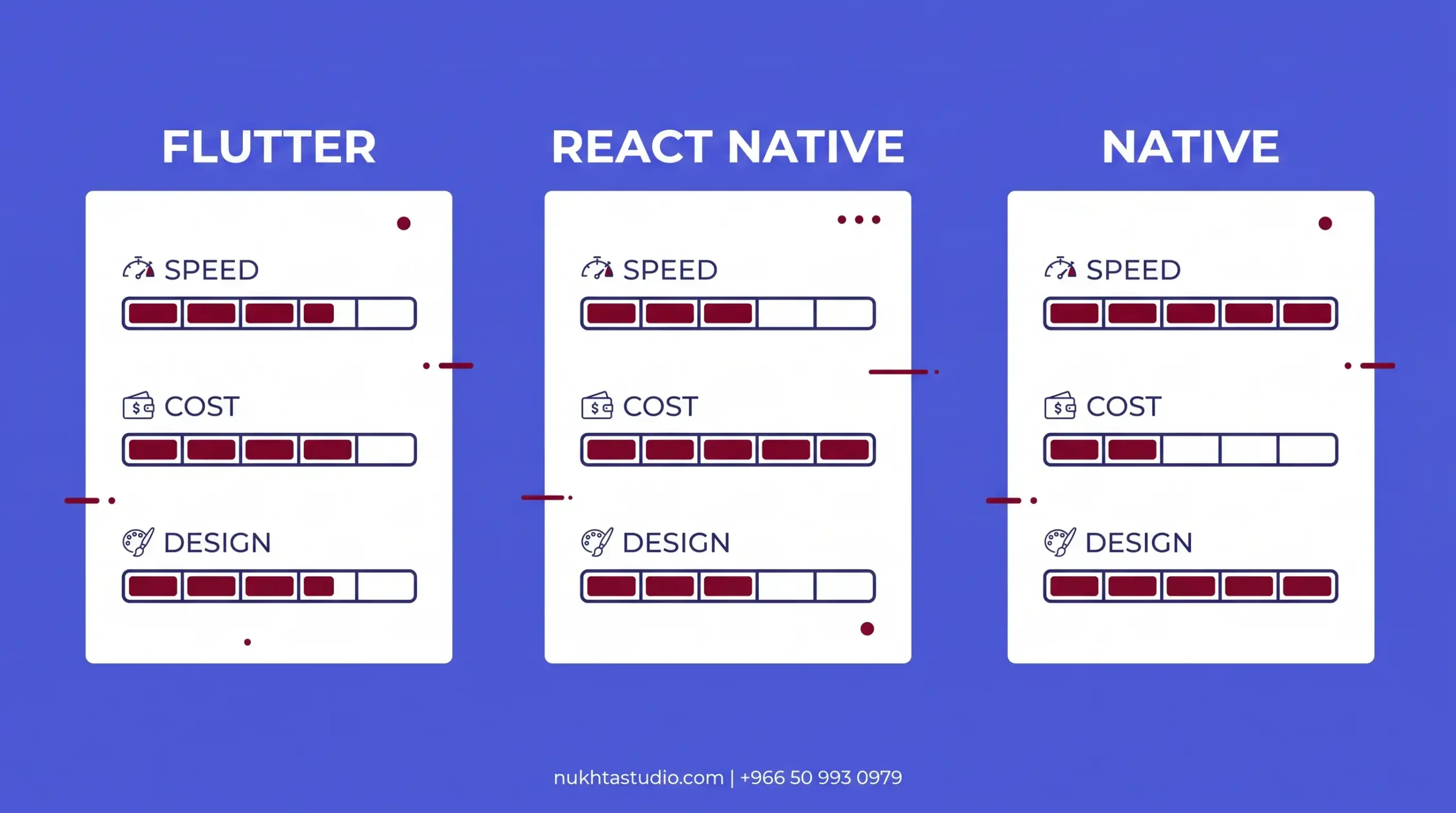
| Performance | Very high | High | Highest |
| UI style | Custom, identical on all devices | Platform native look | Fully platform native |
| Development speed | Fast | Fast | Slower |
| Cost | Lower | Lower | Highest |
| Developer pool | Large and growing | Very large | Large but split by platform |
| New OS features | Short delay | Short delay | Available on day one |
| Best for | MVPs, design-rich apps, multi-platform | Teams with web/React skills, content apps | Games, AR, heavy hardware, high-end apps |
Detailed Comparison
1. Performance
- Native is the fastest. It has no extra layer between your code and the phone.
- Flutter is very close to native for most apps. It compiles to machine code and handles animations at a smooth 60 to 120 frames per second.
- React Native is now fast enough for nearly all business apps thanks to its New Architecture.
For most business apps (ecommerce, booking, delivery, clinics, real estate), users will not feel a difference. Performance only matters a lot for games, augmented reality, video editing, or heavy real-time apps.
2. UI and User Experience
- Flutter gives you full control over design. Your brand looks exactly the same on every phone. Great for custom, animation-rich designs.
- React Native follows each platform’s style automatically. iPhone users get an iPhone feel, Android users get an Android feel.
- Native gives the most authentic experience and the newest design features first.
3. Development Speed and Time to Market
Both Flutter and React Native let you write once and launch on two platforms. This often cuts development time by 30 to 40 percent compared with building two native apps.
Flutter’s hot reload lets developers see changes instantly, which speeds up design work. React Native has fast refresh, which works similarly.
Native takes the longest because each platform is built separately.
4. Cost of Development
| Option | Relative cost | Why |
|---|---|---|
| Flutter | Lower | One codebase, one team |
| React Native | Lower | One codebase, one team |
| Native | Highest | Two codebases, often two teams |
The bigger cost driver is usually your app’s features and complexity, not the framework. A simple app in native can still cost less than a complex app in Flutter.
5. Developer Availability and Hiring
- React Native has the biggest talent pool, because many web developers already know JavaScript and React.
- Flutter has a large and fast-growing community, and its developers are highly productive.
- Native developers are common, but you need both iOS and Android experts.
Think ahead: who will maintain your app in two or three years?
6. Access to Device Features
Camera, GPS, Bluetooth, biometrics (Face ID, fingerprint), push notifications, and payments work well in all three.
Native wins when you need deep or brand-new hardware features, such as advanced AR, health sensors, or new features Apple and Google announce each year. Flutter and React Native can still reach these through plugins or native modules, but sometimes with a short delay.
7. Maintenance and Long-Term Updates
Every year Apple releases a new iOS and Google releases a new Android. Your app needs updates to stay compatible.
- With Flutter or React Native, you update one codebase.
- With Native, you update two.
Cross-platform also means one set of bug fixes and one testing cycle for logic, saving long-term money.
8. Security
All three can be built securely. Security depends more on how the app is built than which framework is used. Good practices include encrypted data storage, secure APIs, code obfuscation, SSL pinning, and following the OWASP Mobile guidelines.
For banking, fintech, and government apps, native gives slightly more direct control, but Flutter is already trusted by many banks.
9. App Size
- Native apps are usually the smallest.
- Flutter apps are a bit larger because they include their own rendering engine.
- React Native apps sit in the middle.
For most users with modern phones, this difference does not matter much.
Arabic and RTL Support for Saudi Apps
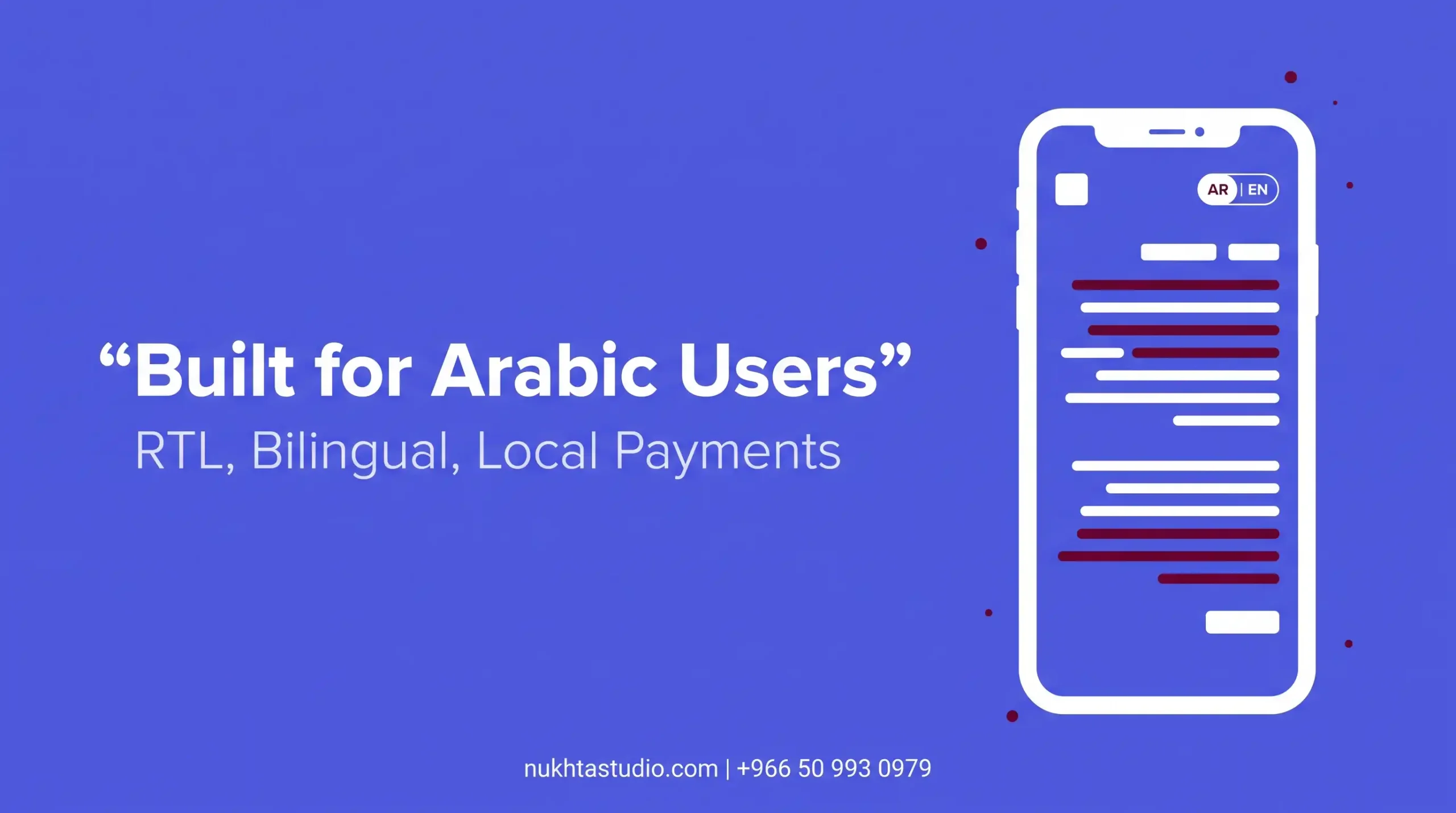
This is where many guides fall short. If your users are in Saudi Arabia, your app must handle Arabic properly.
What a Saudi app needs:
- Right to left (RTL) layout that flips correctly
- Clear Arabic fonts that render well
- Bilingual switching between Arabic and English
- Hijri and Gregorian dates
- Local payment methods like mada, STC Pay, Apple Pay, and Tabby or Tamara (buy now, pay later)
- Compliance with Saudi Arabia’s Personal Data Protection Law (PDPL)
How each option handles it:
- Flutter: Strong built-in RTL and localization support. A very good choice for bilingual apps.
- React Native: Supports RTL well, but some third-party libraries need extra testing.
- Native: Excellent RTL support from Apple and Google.
All three can deliver a great Arabic experience if the team knows what they are doing. Always test with real Arabic content, not just translated placeholder text.
When to Choose Flutter
Flutter is a smart choice if:
- You want to launch on iOS and Android at the same time with one budget
- You are building an MVP to test your idea quickly
- Your app needs a custom, branded design with smooth animations
- You may want a web or desktop version later
- You want a strong Arabic and English bilingual app
Good fits: ecommerce, food delivery, booking apps, fintech, startup MVPs, loyalty apps.
When to Choose React Native
React Native is a smart choice if:
- Your team already works with JavaScript, TypeScript, or React
- You already have a React website and want to share logic
- You want the app to feel native on each platform automatically
- You need a large hiring pool for the future
- Your app connects to many AI or web services
Good fits: social apps, content and media apps, marketplaces, internal company apps, SaaS companion apps.
When to Choose Native
Native is the right choice if:
- Your app needs maximum performance (games, AR, video, real-time streaming)
- You rely heavily on device hardware like sensors, Bluetooth, or wearables
- You want new Apple and Google features on launch day
- You are building for only one platform
- Budget is less of a concern than top quality
Good fits: high-end games, AR and camera apps, health and fitness apps with wearables, large banking apps.
What About Kotlin Multiplatform?
Kotlin Multiplatform (KMP), backed by JetBrains and Google, is a rising option. It lets you share business logic between iOS and Android while keeping native screens. With Compose Multiplatform, you can also share UI.
It suits teams that already have Android developers and want native quality with some code sharing. It is still newer and has a smaller community than Flutter or React Native, so for most Saudi businesses, Flutter or React Native remains the safer pick today.
5 Question Decision Checklist

- What is your budget? Limited budget points to Flutter or React Native.
- How fast do you need to launch? Fast launch points to Flutter or React Native.
- What skills does your team have? JavaScript skills point to React Native. Mobile experts point to Native. Starting fresh points to Flutter.
- How complex are the features? Heavy hardware, AR, or games point to Native.
- How important is a custom brand design? Very important points to Flutter.
If most answers point to one option, that is likely your answer. If you are still unsure, talk to a team that builds with all three.
Common Mistakes to Avoid
- Choosing based on hype. Choose based on your business goals.
- Ignoring maintenance costs. The launch is only the start.
- Forgetting Arabic and RTL testing until the end.
- Picking the cheapest developer instead of the most experienced one.
- Building every feature at once. Start with an MVP, then grow.
- Skipping app store guidelines from Apple and Google, which can delay approval.
Cost of App Development in Riyadh
App development cost in Riyadh depends on:
- Number of screens and features
- Design complexity
- Backend, admin panel, and integrations (payments, maps, CRM)
- Arabic and English support
- Platform choice (cross-platform or native)
As a general guide, a cross-platform app with Flutter or React Native usually costs noticeably less than building separate native iOS and Android apps with the same features. For an accurate number, get a quote based on your exact requirements.
Build Your App With Nukhta Studio in Riyadh
Choosing the right technology is only step one. Building it well is what makes your app succeed.
At Nukhta Studio, we help Riyadh businesses, startups, and enterprises plan, design, and build mobile apps using Flutter, React Native, and Native development. We do not push one tool. We recommend what fits your goals, budget, and users.
What we offer:
- Free consultation to choose the right technology
- iOS and Android app development
- Arabic and English bilingual apps with full RTL support
- Saudi payment integrations (mada, STC Pay, Apple Pay)
- UI and UX design
- App store launch and ongoing maintenance
📞 Call us: 050 993 0979
🌐 Learn more: App Development in Riyadh
Frequently Asked Questions
Is Flutter better than React Native?
Neither is better for everyone. Flutter is great for custom design and multi-platform apps. React Native is great for teams with JavaScript skills. Both are production-ready in 2026.
Is native app development still worth it?
Yes, for apps that need top performance, deep hardware access, or the latest OS features. For most business apps, cross-platform is enough.
Which is cheaper: Flutter, React Native, or Native?
Flutter and React Native are usually cheaper because you build one app for both platforms. Native costs more because you build two.
Can Flutter and React Native apps support Arabic?
Yes. Both support Arabic and right to left layouts. Flutter’s built-in localization is especially strong.
Which big companies use Flutter and React Native?
Google, BMW, and Alibaba use Flutter. Meta, Microsoft, Shopify, and Discord use React Native.
Can I switch from Flutter or React Native to native later?
Yes, but it usually means rebuilding the app. Choose carefully at the start to avoid this cost.
How long does it take to build an app?
A simple MVP can take a few weeks to a few months. Complex apps take longer. Cross-platform is usually faster than native.
Which is best for a startup in Saudi Arabia?
Most startups benefit from Flutter or React Native, because they launch faster on both iOS and Android with one budget.
Conclusion
There is no single winner in the Flutter vs React Native vs Native debate. The right choice depends on your budget, timeline, team, and the experience you want to give users.
- Flutter for fast launches and beautiful custom designs
- React Native for JavaScript teams and native feel
- Native for maximum performance and hardware power
Still unsure? Talk to the Nukhta Studio team for a free consultation. Call 050 993 0979 or visit our app development Riyadh page.
1 thought on “Flutter vs React Native vs Native: Which to Choose?”