Quick answer: Choose Salla if you are starting small in Saudi Arabia and want the lowest cost, including a free plan to test your idea. Choose Zid if you are an established Saudi brand that wants strong local logistics, hands on merchant support, and room to scale. Choose Shopify if your plan is to sell across the GCC and worldwide and you need the largest ecosystem of apps and themes. Many serious brands actually use both: a Saudi platform for local customers and Shopify for international orders.
If you are planning to open an online store in Saudi Arabia, you have probably heard three names again and again: Salla, Zid, and Shopify. Friends who sell perfumes swear by Salla. A brand you admire runs on Zid. Every YouTube course from abroad tells you to use Shopify. So which one is right for you?
The honest answer is that each platform is excellent for a specific type of business, and a poor fit for others. The problem is that most comparison articles online only list features in a table and leave you to work out the rest. That is not enough when you are about to invest your money, your time, and your brand.
In this guide, we go deeper. We explain how each platform handles the things that actually decide success in the Saudi market: how customers pay, how orders reach their doors, how your store looks in Arabic, how you stay compliant with ZATCA and the Ministry of Commerce, how much you really pay each month, and how easily customers can find you on Google. By the end, you will be able to choose with confidence, not guesswork.
Saudi E-commerce in 2026: Why Your Platform Choice Matters So Much
Saudi Arabia has become one of the most exciting online retail markets in the world. Under Vision 2030, the government has pushed hard for a cashless, digital economy, and shoppers have embraced it. Smartphone use in the Kingdom is among the highest globally, young people make up a large share of the population, and buying online has moved from something new to something normal. The wider MENA e-commerce market is valued at over $176 billion in 2026, and Saudi Arabia accounts for more than a third of that value.
This growth is great news, but it also means competition is fierce. When a customer in Riyadh or Dammam lands on your store, they compare you, consciously or not, with the smooth experience they get from large players like Noon, Amazon.sa, and big local brands. If your checkout is confusing, if mada is missing, or if delivery takes a week, they simply close the tab.
Saudi shoppers have a clear set of expectations:
- A proper Arabic experience. Not a translated English site, but a store that reads naturally from right to left, with Arabic product names, Arabic filters, and Arabic invoices.
- Familiar payment methods. mada is the national debit network and is used by almost every adult in the Kingdom. Apple Pay is extremely popular. STC Pay is widely used. Buy now pay later services such as Tabby and Tamara have become a normal part of shopping, especially for fashion, electronics, and beauty.
- Fast delivery with tracking, and in many categories, the option of cash on delivery.
- Transparent pricing in SAR with the 15% VAT clearly included.
- Trust signals such as a Maroof badge, a commercial registration number, and a clear return policy.
Your e-commerce platform is the engine that delivers all of this. Some platforms give you most of it out of the box. Others require apps, developers, and extra monthly costs. That is why the choice matters so much: it affects your costs, your conversion rate, and how quickly you can grow.
Getting to Know the Three Platforms
Before comparing them feature by feature, it helps to understand where each platform comes from and what it was designed to do. A platform’s origin story tells you a lot about its strengths.
Salla (سلة): The Accessible Saudi Favorite
Salla was founded in 2016 in Makkah. Its name means “basket” in Arabic, and the idea behind it was simple: let any Saudi entrepreneur open a professional online store without knowing how to code. That mission still shapes the product today.
Salla is Arabic first. The dashboard, the store themes, the checkout, and the support are all designed for Arabic speaking merchants and customers. Salla reports more than 68,000 active merchants and over $13 billion in processed transactions, almost all in Saudi Arabia and the Gulf. It connects merchants with more than 200 shipping companies and offers an app store with over 900 integrations covering accounting, marketing, customer service, and more.
What makes Salla especially popular with beginners is its free plan. You can create a store on a salla.sa subdomain, add products, and test whether people buy before you commit to a paid subscription. For a home business selling on Instagram or WhatsApp, this low barrier to entry is a big deal.
For larger companies, Salla offers Salla Special, an enterprise level service with multi branch management, ERP and POS integrations, a dedicated account manager, and custom pricing.
Zid (زد): The Growth Partner for Serious Saudi Brands
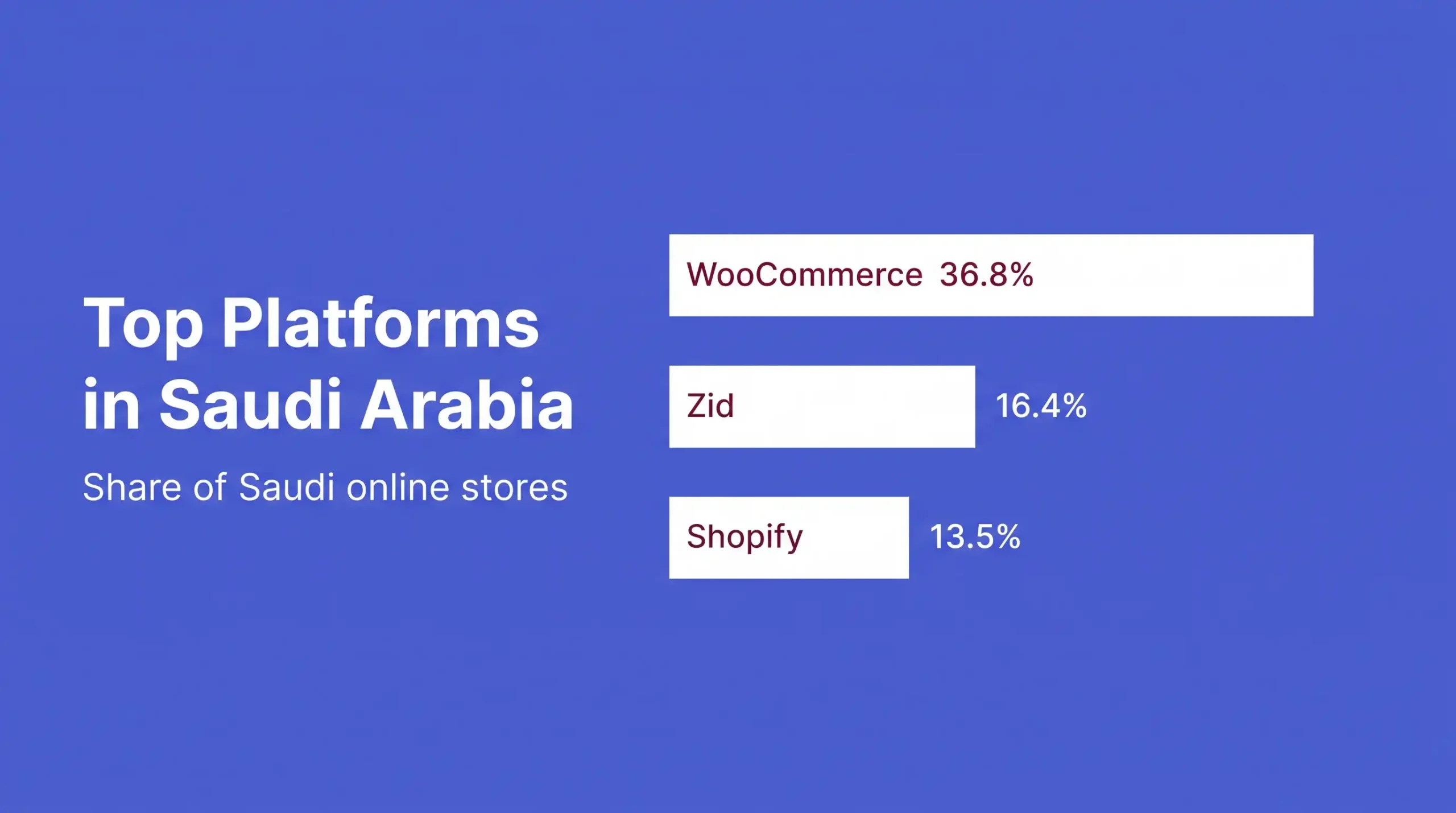
Zid is headquartered in Riyadh and has grown into one of the most widely used store builders in the Kingdom. According to website technology data, Zid is the second most detected e-commerce platform on Saudi websites, behind only WooCommerce and ahead of Shopify.
Where Salla focuses on making it easy to start, Zid positions itself as a partner for growth. It has built a set of services around the store itself:
- Zid Ship gives merchants access to discounted shipping rates and lets them print labels and track orders from one dashboard.
- Zid Pay handles payments, including mada, Apple Pay, credit cards, and buy now pay later options.
- Financing options help merchants fund inventory and marketing.
- A merchant enablement team and Zid Academy offer training, guidance, and strategy support.
- Zid Assurance is designed to increase customer trust and purchase rates.
Zid does not offer a free plan, which tells you who it is designed for. It is aimed at merchants who are already selling and want stronger tools, better operations, and closer support as they scale.
Shopify: The Global Giant
Shopify is a Canadian company and the most popular hosted e-commerce platform in the world, powering millions of stores. Its biggest strength is its ecosystem. The Shopify App Store has more than 8,000 apps, and there are hundreds of professional themes. Whatever feature you can imagine, from subscription boxes to product bundles to advanced loyalty programs, someone has probably built an app for it.
Shopify is also excellent at international selling. Shopify Markets lets you sell in multiple countries with local currencies, languages, and pricing, all from one store.
The catch is that Shopify was not built with Saudi Arabia in mind. Shopify Payments, its own built in payment system, is not available in the Kingdom. Arabic and right to left layouts work, but they depend on choosing the right theme and often adding translation apps. Local couriers and cash on delivery usually require extra apps. None of these are deal breakers, but each one adds setup time and often a monthly cost.
Side by Side Comparison at a Glance

| Feature | Salla | Zid | Shopify |
|---|---|---|---|
| Headquarters | Makkah, KSA | Riyadh, KSA | Ottawa, Canada |
| Free plan | Yes (salla.sa subdomain) | No | No (short trial) |
| Starting paid price | About 99 SAR/month | About 99 SAR/month | About $39/month (around 146 SAR) |
| Arabic and RTL | Native | Native | Theme and app dependent |
| mada, STC Pay, Apple Pay | Built in | Built in | Through third party gateways |
| Tabby and Tamara | Built in | Built in | Through apps or gateways |
| Local shipping network | 200+ partners | Zid Ship plus partners | Mostly through apps |
| App ecosystem | 900+ | 400+ | 8,000+ |
| International selling | Good for GCC | Saudi and Gulf focus | Best in class |
| Best for | Beginners, small and mid size Saudi stores | Growing and established Saudi brands | GCC and global brands |
Prices and plans change often. Always confirm on each platform’s official pricing page before you decide.
The table gives you the big picture, but the real decision lies in the details. Let us go through each area one by one.
Pricing in SAR: What You Really Pay

Most people compare platforms by looking at the monthly subscription. That is a mistake. The subscription is only one part of your total cost, and sometimes not even the biggest part.
Salla Plans Explained
- Free plan. Your store runs on a salla.sa subdomain (for example, yourstore.salla.sa). This is ideal for testing a product idea, but for a serious brand you will want your own domain, which builds trust and helps SEO.
- Salla Plus (about 99 SAR per month). The natural starting point for a real business. You get your own domain and the core features most small stores need.
- Salla Pro (about 299 SAR per month). Adds more advanced marketing tools, reports, and capacity for stores that are growing.
- Salla Special (custom pricing). For large retailers that need multi branch management, ERP integration, POS, and dedicated support.
Zid Plans Explained
- Lite (about 99 SAR per month). A starting plan for merchants who want Zid’s ecosystem from day one.
- Growth (about 399 SAR per month). The plan most growing merchants choose, unlocking more marketing, analytics, and operational features.
- Professional (about 18,000 SAR per year). For high volume stores that need advanced tools and closer support.
- Enterprise. Custom solutions for large brands.
Shopify Plans Explained
- Basic (about $39 per month). Enough to launch a store with core features.
- Grow (about $105 per month). Better reports, more staff accounts, and lower transaction fees.
- Advanced (about $399 per month). For larger stores needing advanced reporting and international features.
- Shopify Plus (custom, usually from around $2,300 per month). For enterprise brands.
Remember that Shopify bills in US dollars, so your cost also moves slightly with exchange rates and bank card fees.
The Hidden Costs Most People Forget
When you build your budget, include these items for every platform:
- Payment processing fees. Every gateway charges a percentage of each order plus sometimes a fixed fee. On a store doing 100,000 SAR in monthly sales, a difference of even half a percent equals 500 SAR a month.
- Paid apps. This is where Shopify stores in Saudi Arabia often spend more. You may need separate apps for Arabic translation, cash on delivery, Saudi couriers, ZATCA invoices, and BNPL. Each one may cost $10 to $50 a month.
- Themes. Salla’s paid themes average around 200 SAR. Premium Shopify themes usually cost between $180 and $400 as a one time purchase.
- Domain name. A .com or .sa domain is a small yearly cost, but a .sa domain requires Saudi documentation.
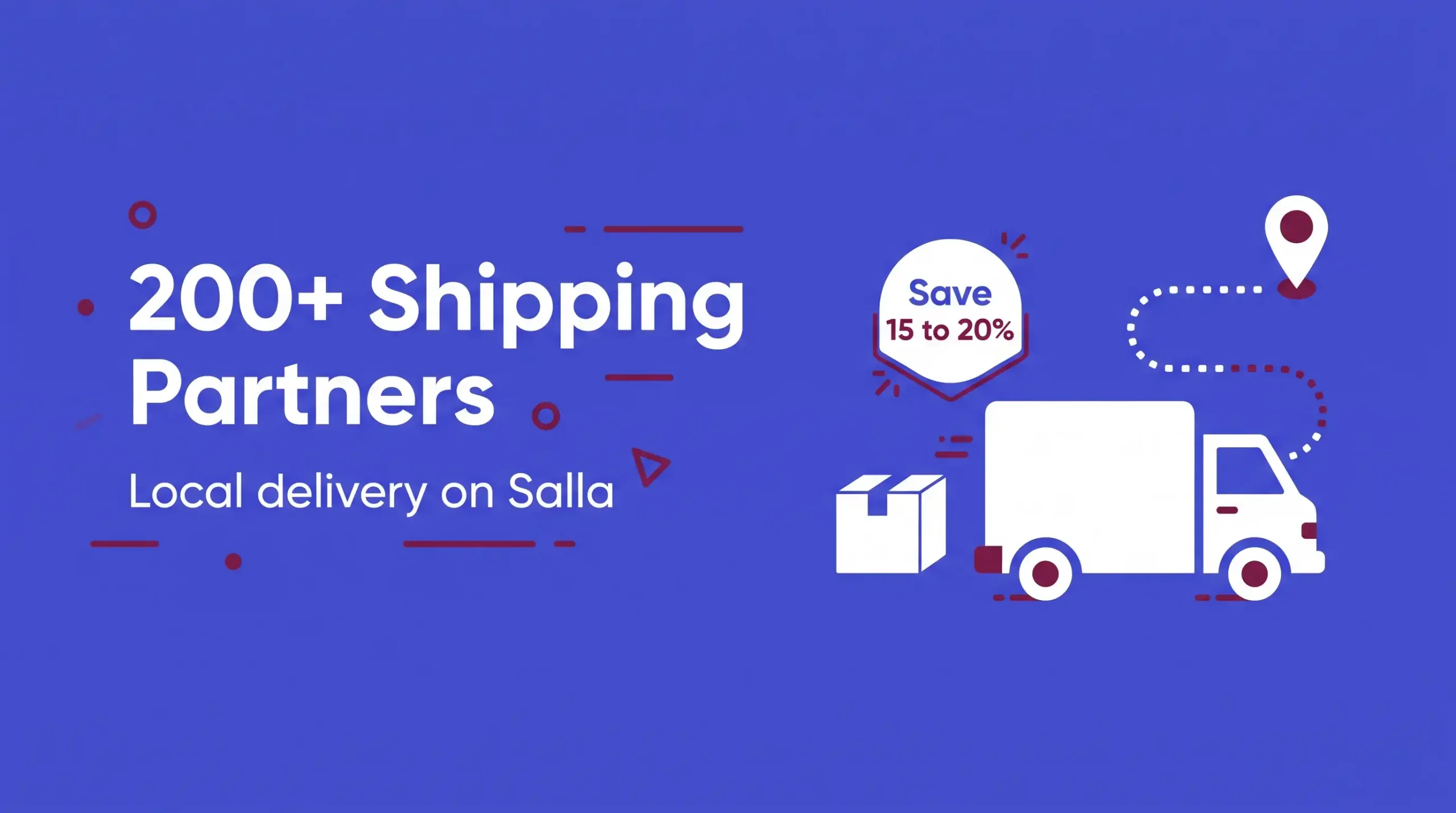
- Shipping costs. Platforms with strong local courier deals can save you a meaningful amount per order. One comparison found Salla’s logistics partnerships save merchants 15 to 20% compared to typical Shopify shipping app rates.
- Design and development. If you hire an agency to customize your store, budget for that too.
A Realistic Example: A Riyadh Fashion Store with 200 Orders a Month
Imagine a small abaya brand in Riyadh selling about 200 orders a month, almost all inside Saudi Arabia.
| Monthly cost item | Salla Pro | Zid Growth | Shopify Basic |
|---|---|---|---|
| Plan subscription | ~299 SAR | ~399 SAR | ~146 SAR |
| Apps for Arabic, COD, local shipping, invoicing | Mostly included | Mostly included | Often 150 to 400 SAR |
| Shipping rates | Discounted local rates | Discounted via Zid Ship | Depends on courier app |
| Estimated platform cost | ~300 to 400 SAR | ~400 to 500 SAR | ~300 to 550 SAR |
On paper, Shopify Basic looks the cheapest. In practice, once you add the apps a Saudi store needs, the total becomes similar or higher, and you still do not get the local shipping discounts. For a store focused on the Saudi market, Salla and Zid usually offer better value. For a store that sells internationally, Shopify’s higher cost buys features the others cannot match.
Payment Gateways: The Factor That Makes or Breaks Your Sales
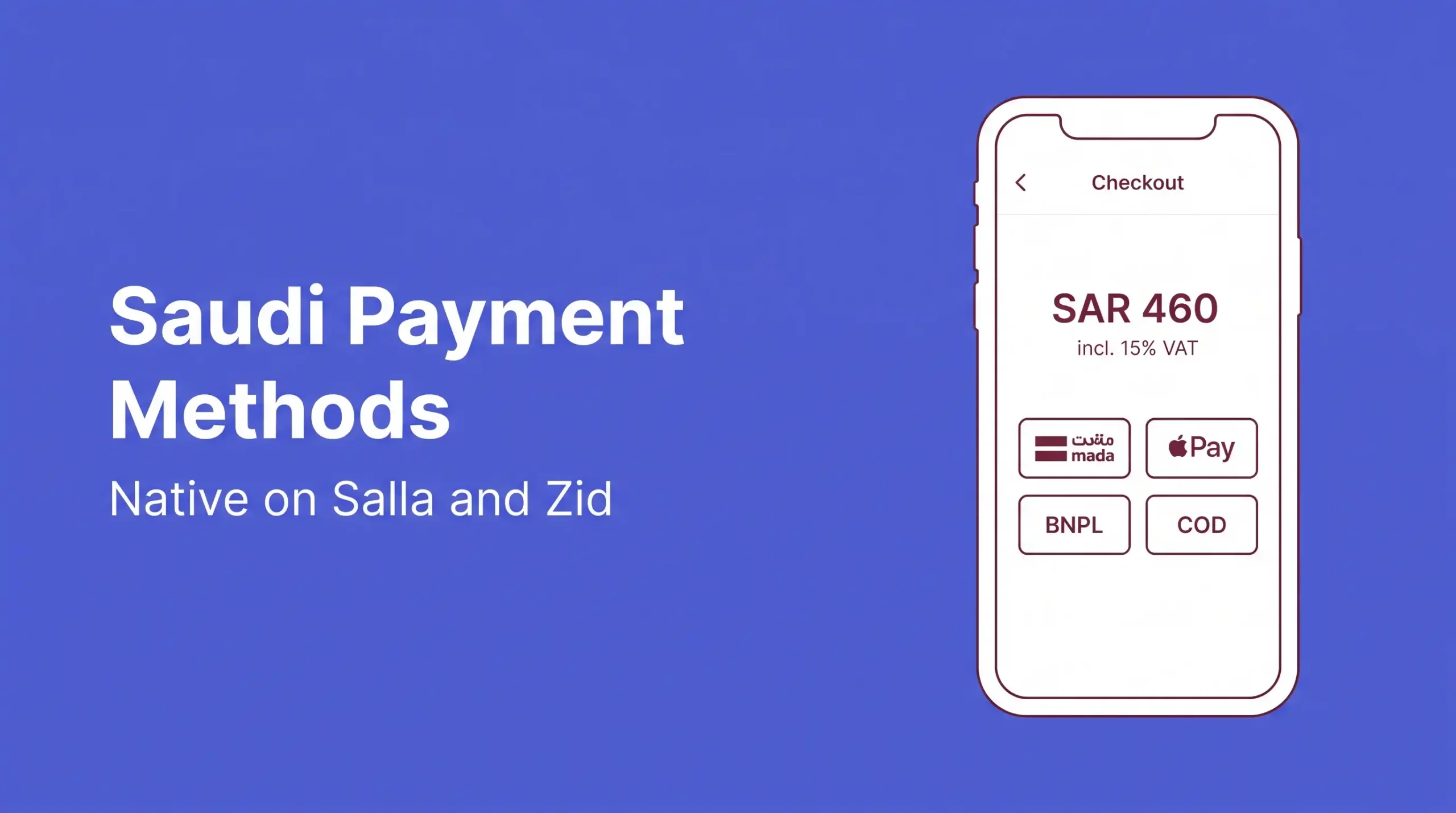
In Saudi Arabia, checkout is where you win or lose the sale. A customer who has filled their cart and then cannot find mada or cannot split the payment with Tabby will often leave, and many never come back.
Salla
Salla supports the full range of popular Saudi payment methods natively: mada, Apple Pay, STC Pay, Visa, Mastercard, Tabby, Tamara, and cash on delivery. “Natively” means you activate them from your dashboard without hunting for third party apps. The checkout is designed for Saudi customers, so it feels familiar.
Zid
Zid offers Zid Pay along with mada, Apple Pay, STC Pay, credit cards, buy now pay later providers, and cash on delivery. Having payments and shipping inside the same ecosystem also makes reconciliation easier: you can see what was paid, what was shipped, and what is pending in one place.
Shopify
Shopify Payments is not available in Saudi Arabia, so you need to connect a third party gateway. Popular options include Tap Payments, HyperPay, PayTabs, Moyasar, and Checkout.com, many of which support mada and Apple Pay. BNPL providers like Tabby and Tamara can be added through apps or integrations.
This setup works well when done properly, but there are trade offs. Shopify may charge an extra transaction fee when you use a third party gateway instead of Shopify Payments. Some gateways redirect customers to a separate payment page, which can add friction. And each integration is one more thing to maintain.
Verdict: For Saudi focused stores, Salla and Zid are clearly ahead. Shopify can match them, but it takes more setup and may cost more per transaction.
Shipping and Logistics: Getting Orders to Customers Fast
Delivery speed is one of the biggest drivers of repeat purchases. Customers in Riyadh, Jeddah, and the Eastern Province increasingly expect delivery in one to three days.
Salla
Salla connects with more than 200 shipping companies, both local and international. This includes well known Saudi carriers such as Aramex, SMSA, and SPL (Saudi Post), as well as last mile and same day services. Merchants can compare rates, print shipping labels, and send tracking updates to customers without leaving the dashboard.
Zid
Zid’s answer is Zid Ship, an integrated logistics service that negotiates discounted rates with carriers on behalf of merchants. You create shipments, print labels, and track deliveries in one place. Zid also offers fulfillment options, which means a partner can store your inventory, pack orders, and ship them for you. For a growing brand, this can free up a lot of time.
Shopify
Shopify relies on apps to connect with Saudi couriers. There are good options available, but you will not automatically receive the negotiated local rates that Salla and Zid provide. Where Shopify shines is international shipping. If you plan to ship to Europe, the US, or Asia, Shopify’s ecosystem of global carriers and fulfillment services is much stronger.
Verdict: Salla and Zid win for local delivery. Shopify wins for global shipping.
Arabic Language, Right to Left Design, and Store Themes
Language is about trust. A Saudi customer who sees awkward Arabic, text running in the wrong direction, or English error messages at checkout will hesitate before entering card details.
Salla and Zid are built Arabic first. The admin dashboard, themes, checkout, invoices, notification messages, and customer accounts all support right to left layouts out of the box. You can easily add an English version of your store too. Salla also supports more than 40 languages and multi currency, which helps when selling to other Gulf countries.
Shopify supports Arabic, but the quality depends on your choices. Not every theme handles right to left correctly, so you need to pick one that is RTL ready and test it thoroughly. For a bilingual store, you may need a translation app. Checkout pages also need testing to ensure everything displays correctly. With the right theme and setup, a Shopify store can look excellent in Arabic, but it requires more care.
When it comes to design freedom, Shopify has the edge. Its theme library is huge, and developers can customize almost anything. Salla and Zid themes are clean and professional, and both allow customization, but advanced, highly unique designs are easier to achieve on Shopify.
Saudi Compliance: ZATCA, VAT, Maroof, CR, and PDPL
This is the section most comparison articles ignore, yet it can cause real headaches if you get it wrong. Running an online store in Saudi Arabia comes with specific legal requirements.
Commercial Registration (CR) or Freelance Document
To sell online legally, you need either a commercial registration from the Ministry of Commerce or a freelance document for eligible individuals. Payment gateways also require this before they activate your account. This applies no matter which platform you choose.
VAT at 15%
If your business is registered for VAT, your prices must include the 15% tax and your invoices must show it correctly. Salla and Zid are configured for Saudi VAT, making setup straightforward. On Shopify, you need to configure tax settings carefully and confirm that prices display correctly.
ZATCA E-invoicing (Fatoorah)
The Zakat, Tax and Customs Authority (ZATCA) requires businesses to issue electronic invoices that meet specific standards, including a QR code and specific data fields. This is being rolled out in phases, and more businesses are brought in over time. Salla and Zid provide built in or connected solutions designed for Saudi requirements. On Shopify, you typically need a dedicated app or accounting integration to stay compliant.
Maroof
Maroof is a Ministry of Commerce service that verifies online stores and shows customer ratings. Displaying the Maroof badge increases trust, especially for new stores. Linking it is simple on Salla and Zid.
Personal Data Protection Law (PDPL)
Saudi Arabia’s PDPL governs how businesses collect and use customer data. On any platform, you need a clear privacy policy, proper consent for marketing messages, and secure handling of customer information.
Verdict: Salla and Zid make compliance much easier because they were designed for these rules. Shopify can be made compliant, but it relies on apps and careful setup.
Apps and Integrations: Extending Your Store
No platform does everything on its own. Apps let you add features such as reviews, loyalty programs, email marketing, abandoned cart recovery, and accounting integrations.
Shopify is the undisputed leader here, with more than 8,000 apps. If you want advanced marketing automation, subscription selling, product personalization, or sophisticated upsells, you will find more options on Shopify than anywhere else.
Salla offers more than 900 apps, and many of them are built specifically for the Saudi market. This includes integrations with local accounting software such as Qoyod and Daftra, WhatsApp marketing tools, and local loyalty and review solutions.
Zid has more than 400 apps, alongside its own services for shipping, payments, POS, and financing. Because many core functions are built into Zid itself, you often need fewer apps.
Verdict: Shopify for variety and advanced features. Salla for local apps. Zid for an all in one ecosystem.
SEO and AI Search Visibility: Getting Found Online
Paid ads can bring quick traffic, but they get expensive. Ranking on Google, and now appearing in AI powered answers from Google AI Overviews, ChatGPT, and Gemini, brings free, steady visitors month after month. Your platform affects how easy this is.
What Every Store Needs for Good SEO
- Editable page titles and meta descriptions for every product and category
- Clean, readable URLs in Arabic and English
- Fast loading pages, especially on mobile
- Image alt text describing your products
- Structured data (schema markup) for products, prices, reviews, and FAQs
- A blog for publishing helpful content
- An XML sitemap and hreflang tags for Arabic and English versions
How the Platforms Compare
Shopify has mature SEO features and a huge choice of SEO apps. Its main limitation is a fixed URL structure, for example /products/ and /collections/, which you cannot change. In practice, this does not stop Shopify stores from ranking well.
Salla and Zid handle the essentials: editable titles and descriptions, sitemaps, and mobile friendly themes. Both have been improving their SEO tools. Deep technical control, such as advanced schema customization, is more limited than on Shopify.
The Expert Truth About E-commerce SEO
After years of working with Saudi stores, one lesson stands out: the platform matters far less than the strategy. A well optimized Salla store will beat a neglected Shopify store every time. What actually moves rankings is:
- Unique product descriptions written in natural Arabic and English, not copied from suppliers.
- Category pages with helpful content explaining what customers should look for.
- Internal links that connect related products and articles.
- A Google Business Profile if you have a physical location in Riyadh or elsewhere.
- Quality backlinks from Saudi websites, news sites, and partners.
For AI search, structure matters. AI tools prefer content that answers questions clearly, uses FAQ sections, and presents consistent brand information across your website, social profiles, and directories.
Selling Beyond Saudi Arabia: GCC and Global Expansion
If your ambitions go beyond the Kingdom, your platform choice becomes even more important.
Shopify is the strongest option for international selling. Shopify Markets lets you set local prices, currencies, and languages for each country from one store, and its global shipping and tax tools are mature.
Salla supports multi currency and Gulf shipping, which makes it a solid option for expanding into the UAE, Kuwait, Bahrain, Qatar, and Oman.
Zid is focused mainly on Saudi Arabia and nearby Gulf markets.
A common strategy among growing brands is to run two stores: a Salla or Zid store optimized for Saudi customers, and a Shopify store for international buyers. This gives you the best of both worlds, though it does mean managing inventory across two systems.
Customer Support and Learning Resources
When something breaks at 10 pm during a White Friday sale, support matters.
Salla offers Arabic support, a detailed help center, and active community groups. Salla Special customers receive dedicated account managers.
Zid is often praised for its merchant enablement team, which works closely with merchants on growth. Zid Academy provides courses on e-commerce, marketing, and operations.
Shopify provides 24/7 support, mostly in English, along with a huge global community, endless tutorials, and a large network of certified partners and agencies.
Pros and Cons Summary
Salla
Pros
- Free plan lets you test with no risk
- Lowest starting cost for a real store
- Native Saudi payments, shipping, and compliance
- Arabic first experience
- Large library of local apps
Cons
- Less design flexibility than Shopify
- More limited advanced SEO control
- Free plan uses a subdomain, which looks less professional
Zid
Pros
- Built for growing Saudi brands
- Zid Ship, Zid Pay, and financing in one ecosystem
- Strong merchant support and training
- High market share in Saudi Arabia
Cons
- No free plan
- Mid tier plans cost more than Salla
- Smaller app store
Shopify
Pros
- Largest app and theme ecosystem
- Best platform for international selling
- Highly scalable, from small shops to global brands
- Strong SEO tools and community
Cons
- Shopify Payments not available in Saudi Arabia
- Needs extra apps for Arabic, local shipping, and invoicing
- Costs in USD and can grow quickly with apps
Which Platform Fits Your Business?
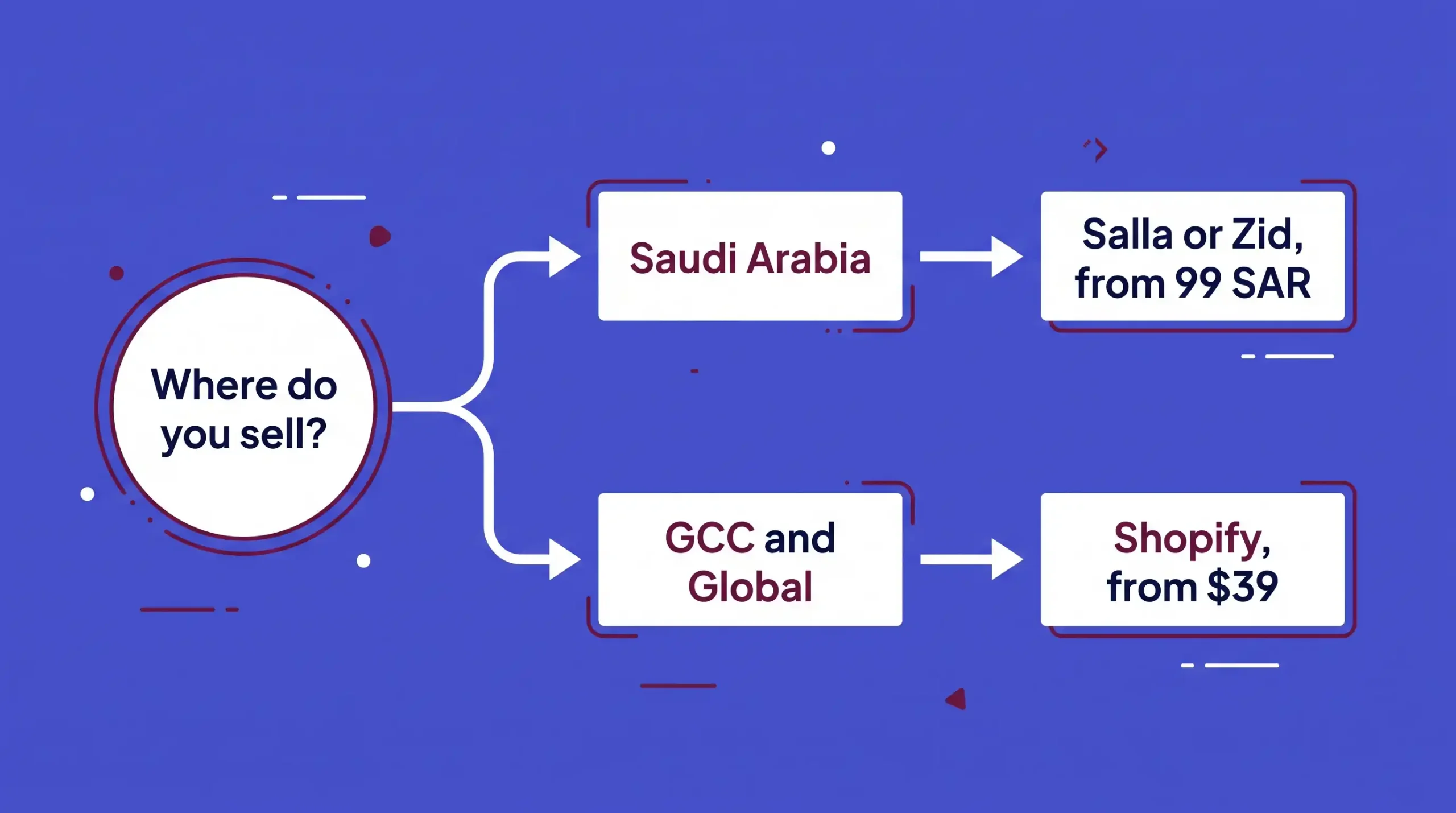
| Your situation | Best choice | Why |
|---|---|---|
| Just starting, small budget, selling on Instagram or WhatsApp | Salla | Free plan, low cost, everything Saudi built in |
| Established Saudi brand with steady orders | Zid | Better logistics, financing, and growth support |
| Selling across the GCC and worldwide | Shopify | Best international tools and apps |
| Foreign brand already on Shopify entering Saudi | Shopify with local gateways, or add a Salla or Zid store | Keep your system, or go fully local for KSA |
| Large retailer with branches, POS, and ERP | Salla Special, Zid Enterprise, or Shopify Plus | Compare custom quotes |
The simple rule: if most of your customers are in Saudi Arabia, start with Salla or Zid. If your customers are spread across the world, choose Shopify.
Migrating Between Platforms Without Losing Sales
Sometimes businesses outgrow their first platform. Moving is very possible, but doing it carelessly can wipe out your Google rankings overnight.
- Export your data. Download products, customers, and order history as CSV files.
- Map your URLs. List every old product and category URL and its new address.
- Set up 301 redirects. These tell Google the page has moved permanently, so you keep your rankings. Skipping this is the most common and costly migration mistake.
- Recreate SEO details. Copy titles, descriptions, and image alt text.
- Reconnect operations. Set up payments, shipping, VAT, and ZATCA invoicing again.
- Test everything. Place test orders on mobile and desktop, in Arabic and English.
- Submit your new sitemap in Google Search Console and watch for errors over the following weeks.
Both Salla and Zid offer migration assistance for merchants moving from other platforms, and an experienced agency can handle the technical side for you.
Common Mistakes Saudi Store Owners Make
- Choosing by monthly price only. As we showed, apps and shipping can change the real cost completely.
- Launching without key payment methods. No mada or no BNPL means lost sales.
- Copying supplier descriptions. Duplicate content hurts SEO and does not persuade Saudi customers.
- Leaving SEO until later. Fixing a store after launch costs more than doing it right from the start.
- Ignoring trust signals. Missing Maroof, CR details, or return policies reduces conversions.
- Heavy images and slow mobile pages. Most Saudi shoppers browse on their phones.
Need Help Building Your Store in Riyadh? Talk to Nukhta Studio
Choosing the right platform is the first step. Building a store that attracts visitors and turns them into loyal customers is where the real work begins.
Nukhta Studio is a Riyadh based web, app, and SEO agency that helps Saudi businesses launch and grow online. Whether you choose Salla, Zid, or Shopify, our team can help you:
- Choose the right platform based on your products, budget, and growth plans
- Design a professional bilingual store with smooth Arabic right to left layouts
- Set up payments, shipping, VAT, and ZATCA e-invoicing correctly from day one
- Migrate your existing store safely, without losing your Google rankings
- Grow your traffic with expert SEO that helps you rank on Google and appear in AI search answers
- Build custom websites and mobile apps that strengthen your brand
📞 Call or WhatsApp: 050 993 0979 🌐 Website: nukhtastudio.com
Book a free consultation, and we will give you a clear, honest recommendation for your business.
Frequently Asked Questions
1. Which is better for Saudi Arabia, Salla or Zid? Both are excellent Saudi platforms. Salla is usually better for beginners because it offers a free plan and a lower starting cost. Zid is a stronger fit for established brands that want integrated shipping, financing, and closer support as they scale.
2. Can I use Shopify in Saudi Arabia? Yes. Shopify works well in Saudi Arabia and many local brands use it. However, Shopify Payments is not available, so you will connect a local gateway such as Tap Payments, HyperPay, PayTabs, or Moyasar to accept mada and Apple Pay.
3. Is Salla really free? Salla has a free plan that runs on a salla.sa subdomain, which is useful for testing. For a professional store with your own domain, paid plans start at around 99 SAR per month.
4. Does Zid have a free plan? No. Zid’s plans start at around 99 SAR per month, reflecting its focus on merchants who are ready to sell seriously.
5. Which platforms support mada, Tabby, and Tamara? Salla and Zid support all of them natively. Shopify can support them through third party gateways and apps.
6. Do I need a commercial registration to open an online store? Yes. You need either a commercial registration or a freelance document. Payment gateways also require it before activating your account.
7. Which platform is best for SEO? Shopify offers the most SEO tools and apps, but Salla and Zid stores can rank very well with strong content, fast pages, and proper technical setup. Strategy matters more than the platform.
8. Can I move my store from Salla to Shopify, or from Shopify to Zid? Yes. Export your data, set up 301 redirects, recreate your SEO details, and test thoroughly before launch. Professional help reduces the risk of losing traffic.
9. Which platform is cheapest overall? For a store selling mainly in Saudi Arabia, Salla is usually the most affordable overall. Shopify’s lower entry price can rise quickly once you add the apps a Saudi store needs.
10. Which platform is best for dropshipping in Saudi Arabia? Shopify has the widest range of dropshipping apps for global suppliers. Salla and Zid also offer dropshipping apps, with a stronger focus on local and regional suppliers and faster local delivery.
Final Verdict
There is no single best platform for every business, but there is a best platform for yours.
- Salla is the smart choice for beginners and budget conscious Saudi stores that want everything local built in.
- Zid is the strong choice for growing Saudi brands that value logistics, financing, and hands on support.
- Shopify is the right choice for brands with GCC and global ambitions that need maximum flexibility.
Before you decide, think about three questions: where are your customers, how fast do you want to grow, and what is your total budget including apps, shipping, and design? Answer those honestly, and the right platform becomes clear.
If you would like an expert opinion, the team at Nukhta Studio in Riyadh is ready to help you choose, build, and grow your online store. Call 050 993 0979 or visit nukhtastudio.com today.